

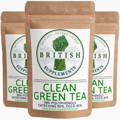
Clean Green Tea Extract (Polyphenols 1,127mg
Catechins 920mg ,EGCG 517mg)
Supplement details
Product Name: Green Tea Extract
Scientific Name: Camellia sinensis
What is it? Green tea extract - Camellia sinensis
Same plant as every cup of builder's tea in Britain, the difference is what happens after picking. Black tea is left to oxidise until the leaf goes dark; green tea is steamed or pan-fired within hours of picking to stop that happening, which is why it stays green and why the leaf's catechins survive.
Catechins are the astringent polyphenols that give strong green tea its bite, and the biggest of them is EGCG, epigallocatechin gallate, which is what an extract is standardised to.
Why the name.Camellia after Georg Kamel, a Jesuit botanist in the Philippines; sinensis, "from China". "Tea" itself came into English two ways: from the Amoy dialect te, via Dutch traders, hence tea, thé, Tee, and from Cantonese cha, via the overland route, hence chai and, on the docks of London, "a cup of char". EGCG is chemists' shorthand for a molecule nobody can pronounce.
How long people have used it. Longer than almost anything on this site. Chinese tradition dates it to the Emperor Shennong in 2737 BC, which is legend; the oldest physical tea found is real leaves in the tomb of the Han Emperor Jing near Xi'an, buried in 141 BC and identified in 2016.
By the Tang dynasty tea was universal in China: Lu Yu wrote The Classic of Tea, the first book on the subject, around 760 AD, and Buddhist monks carried the habit to Japan, where the monk Eisai planted seeds brought from China in 1191 and wrote Japan's first tea book in 1211.
The Japanese turned powdered green tea into matcha and, under Sen no Rikyū in the 1500s, into the tea ceremony. Europe got tea from the Portuguese and Dutch in the early 1600s; London's first advertised sale was at Garway's coffee house in 1657, and Catherine of Braganza made it fashionable at court from 1662.
The UK went for black tea because it survived a six-month voyage; China and Japan stayed green.
The chemistry is twentieth-century and partly British. Michiyo Tsujimura, the first woman in Japan to earn a doctorate in agriculture, isolated catechin from green tea at RIKEN in 1929, tannin in 1930 and gallocatechin in 1934.
EGCG itself was isolated and named in 1948 by A. E. Bradfield and Mary Penney, two chemists in England publishing in the Journal of the Chemical Society. Standardised extracts came out of Japan and China in the 1980s and 90s.
Who used it. Everyone in East Asia for two thousand years, monks first: Chinese Chan and Japanese Zen monasteries were where tea culture was kept and spread, because monks drank it to stay awake through night meditation, the one traditional use it's safe to name, since caffeine is a food fact not a health claim.
Robert Fortune, a Scottish botanist working for the East India Company, smuggled tea plants and Chinese tea-makers out of China to India in 1848–51, from which Assam and Darjeeling tea originate.
In the Western herbal tradition tea turns up in the 1898 King's American Dispensatory and in Maud Grieve's A Modern Herbal of 1931, though the Western herbalists mostly treated it as a stimulant beverage rather than a remedy, the reverence for green tea specifically is a Japanese and Chinese thing that reached the West in the 1980s.
Which part of the plant is used ? The Green Tea Leafs
Strength / Specs ? 20/1 / 98% Polyphenols, Catechins 80%, EGCG 45%
What exactly is in the Veg Capsules ? Green Tea extract in veg caps.
What exactly do we get per dose (2 capsules)? 1,150mg Green Tea extract (Polyphenols 1,127mg, Catechins 920mg ,EGCG 517mg) plus 115mg of our uptake blend 1:1:1 (Black Pepper extract (10% Piperine) Ginger Extract (5% Ginerol) Cumin extract (10:1) in Vegetarian capsules (HPMC). We sell all of our products in monthly packs so its easy to buy and rebuy things that help us.


