

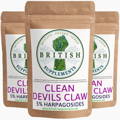
Clean Genuine Devil's Claws 588mg (29.4 Harpagosides)
Supplement details
Product Name: Devils Claws
Scientific Name: Harpagophytum
Other Known Names: Wood spider, Grapple plant teufelskralle, m
What is it? Devil's claw - Harpagophytum procumbens
A low, sprawling perennial that grows in the red sands of the Kalahari, Namibia, Botswana, the Northern Cape and nowhere else. It's a strange plant: a trailing vine above ground with big trumpet-shaped pink flowers, and below it a central taproot that sends out fat secondary tubers, sometimes a metre out from the plant, which is what's harvested.
The tubers are sliced, sun-dried and shipped; the bitter iridoid glycosides in them, mainly harpagoside, are what an extract is standardised to. Ours is 5% harpagosides.
Why the name. Look at the fruit. It's a woody capsule armed with curved, barbed hooks up to several centimetres long, evolved to snag the feet and hides of passing animals so the seed gets carried off.
Anything that treads on one, antelope, cattle, a bare foot, is in trouble, and the local names all say so: duiwelsklou in Afrikaans, Teufelskralle in German, and the botanical name Harpagophytum means "grappling-hook plant". "Grapple plant" and "wood spider" are the older English names. Procumbens just means it lies flat.
How long people have used it. For as long as the San and Khoi peoples have lived in the Kalahari, which is longer than anyone can put a number on, they were digging the tubers before there were written records of the region, and the Tswana, Herero and Nama peoples took the knowledge from them.
Beyond that we don't say. The plant reached Europe through the German colony of South West Africa, now Namibia, where a farmer called G. H. Mehnert is generally credited with learning about it from a local healer around 1907 and sending dried tubers to Germany.
Nothing much happened for forty years. The German botanist Otto Heinrich Volk brought it back to attention in the early 1950s, the pharmacognosist Bruno Zorn published on it in 1958, and harpagoside itself was isolated and named in 1962.
Germany has been the biggest market ever since; France, Switzerland and the UK followed in the 1970s and 80s.
Who used it. The San first and longest. Then, from mid-century, German pharmacists have had it in the German pharmacopoeia and in every serious German herbal since the 1960s and 70s.
Today devil's claw is Namibia's biggest plant export by a distance: several hundred tonnes of dried tuber a year, dug by hand by rural harvesters in the Omaheke and Otjozondjupa regions and the Kavango, most of it going to Europe.
Which part of the plant is used ? Root
Strength / Specs ? 5% Harpagosides
What exactly do we get ? Each Capsule has 588mg Devils Claw extract which gives us 29.4mg Harpagosides plus 65mg of our Uptake blend (1:1:1) Black Pepper extract (10% piperine), Ginger extract (5% Ginerol), Cumin extract (10:1). We sell all of our products in monthly packs so it's easy to buy and rebuy things that help us.


