

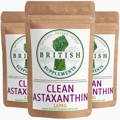
Clean Astaxanthin
Supplement details
Product Name: Astaxanthin
9 Parts Astaxanthin 1 part uptake blend
Other Known Names: Haematococcus Pluvialis extract, Astaxantina , Ovoester, Microalgue, Micro-Algue, Microalgae, and Astaxanthine.
What is it? Astaxanthin - from Haematococcus pluvialis
Astaxanthin is the red pigment. It's a carotenoid, the same family as the orange in carrots and the yellow in egg yolk, and it's what makes salmon flesh pink, lobsters go red in the pot, and flamingos flamingo-coloured, none of them make it, they all eat it.
The richest natural source known is a freshwater microalga, Haematococcus pluvialis, a tiny green single cell that lives in puddles, rock pools and bird-baths across the temperate world.
When its pool starts to dry out or the sun gets too strong, it stops swimming, hardens into a cyst and floods itself with astaxanthin as a sunscreen, turning from green to blood-red. That red resting cell is what's harvested.
Why the name.Haematococcus pluvialis is Latin for "blood-berry of the rain" — haema- blood, -coccus berry, pluvialis rainwater, named by the Prussian botanist Julius von Flotow in 1844, who found it turning rainwater troughs red. Astaxanthin is from Astacus, the crayfish genus it was first pulled out of, plus -xanthin, the chemists' suffix for a yellow-to-red carotenoid.
How long people have used it. In food, for as long as people have eaten anything pink from the sea, salmon, trout, prawns, crayfish, krill, lobster. As a known pigment, since 1938, when Richard Kuhn in Heidelberg, the same Kuhn who'd isolated riboflavin five years earlier and won the Nobel that year, extracted it from lobster shell with Nils Sørensen and named it.
The link to Haematococcus was made in the same decade by Johannes Tischer, who worked out that the alga's red colour was the same molecule. Nobody did much with that for forty years.
Then salmon farming took off in Norway and Scotland in the 1970s and farmed fish came out grey, no krill, no colour, and the feed industry needed astaxanthin by the tonne. Roche synthesised it in the 1980s and that's still what colours most farmed salmon.
Which part of the plant is used ? Algae extract
Strength / Specs ? 3%
What exactly do we get ? Each Capsule has 556mg Haematococcus Pluvialis extract which we get 16mg of Astaxanthin from plus 62mg of our Uptake blend (1:1:1) Black Pepper extract (10% piperine), Ginger extract (5% Ginerol), Cumin extract (10:1). We sell all of our products in monthly packs so it's easy to buy and rebuy things that help us.


