

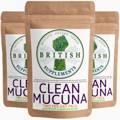
Mucuna Extract 240mg per capsule sold as two per day.
Supplement details
Product Name: Mucuna Pruriens Extract
Scientific Name: Mucuna Pruriens
Other Known Names: Velvet bean, Bengal velvet bean, Florida velvet bean, Mauritius velvet bean, Yokohama velvet bean, cowage, cowitch, lacuna bean, and Lyon bean
What is it? Mucuna pruriens - the velvet bean
A fast-growing tropical climbing legume, family Fabaceae, native to Africa and southern Asia and now grown across India, West Africa, the Caribbean and Central America. It puts out long drooping clusters of purple flowers, then hairy seed pods, and it's the black or mottled beans inside those pods that we use. Nothing else from the plant.
Why the name.Pruriens is Latin for "itching", and it's earned. The pods are covered in fine orange hairs that cause a ferocious itch on contact, the same hairs sold for generations as novelty itching powder, and the reason the old English name is "cowhage" or "cow-itch".
The Sanskrit name kapikacchu means "monkey itch", the story being that even monkeys won't go near the pods. In Nigeria the Yoruba call it werepe; in Central America it's known as the nescafé bean, because the roasted seeds were brewed as a coffee substitute; in Florida a century ago it was simply "velvet bean".
How long people have used it. Roughly two thousand years that we can document in India. Mucuna appears in the classical Ayurvedic texts, the Charaka Samhita and Sushruta Samhita,
compiled in the early centuries AD from older tradition, and it's been in continuous Ayurvedic and Unani practice ever since. In West Africa the beans have been eaten as a food for as long as there are records, boiled or soaked to prepare them.
Who used it. In India, Ayurvedic practitioners and households across the subcontinent for the whole of that period. In Nigeria, Ghana and across the Gulf of Guinea, farming communities who grew it as a bean crop and a soil-restoring cover plant.
In the 20th century American and Central American farmers took it up on an enormous scale, Florida cattle country in the 1900s-20s, then Guatemala, Honduras and southern Mexico, where it's still planted between maize crops as frijol abono, "fertiliser bean", because it fixes nitrogen and smothers weeds.
And in 1937 two chemists in India, Damodaran and Ramaswamy, isolated L-DOPA from Mucuna seed and published it in the Biochemical Journal, the first time that molecule had been found in any plant in quantity. That is why the seed matters to chemists to this day: it remains the richest natural source of L-DOPA known.
Which part of the plant is used ? The seeds
Strength / Specs ? 99% L-Dopa
Extraction method ? Water
What exactly do we get ? Each Capsule has 240mg Mucuna Extract - 99% L-Dopa which is 237.6mg L-Dopa. Uptake blend 27mg 1:1:1: Black Pepper extract (10% piperine), Ginger extract (5% Ginerol), Cumin extract (10:1) per capsule. We sell all of our products in monthly packs so it's easy to buy and rebuy things that help us.


